.png)


The Agentic Customer: What Happens When AI Starts Comparing, Choosing and Buying for People
-
Marketing Garage
- November 3, 2026
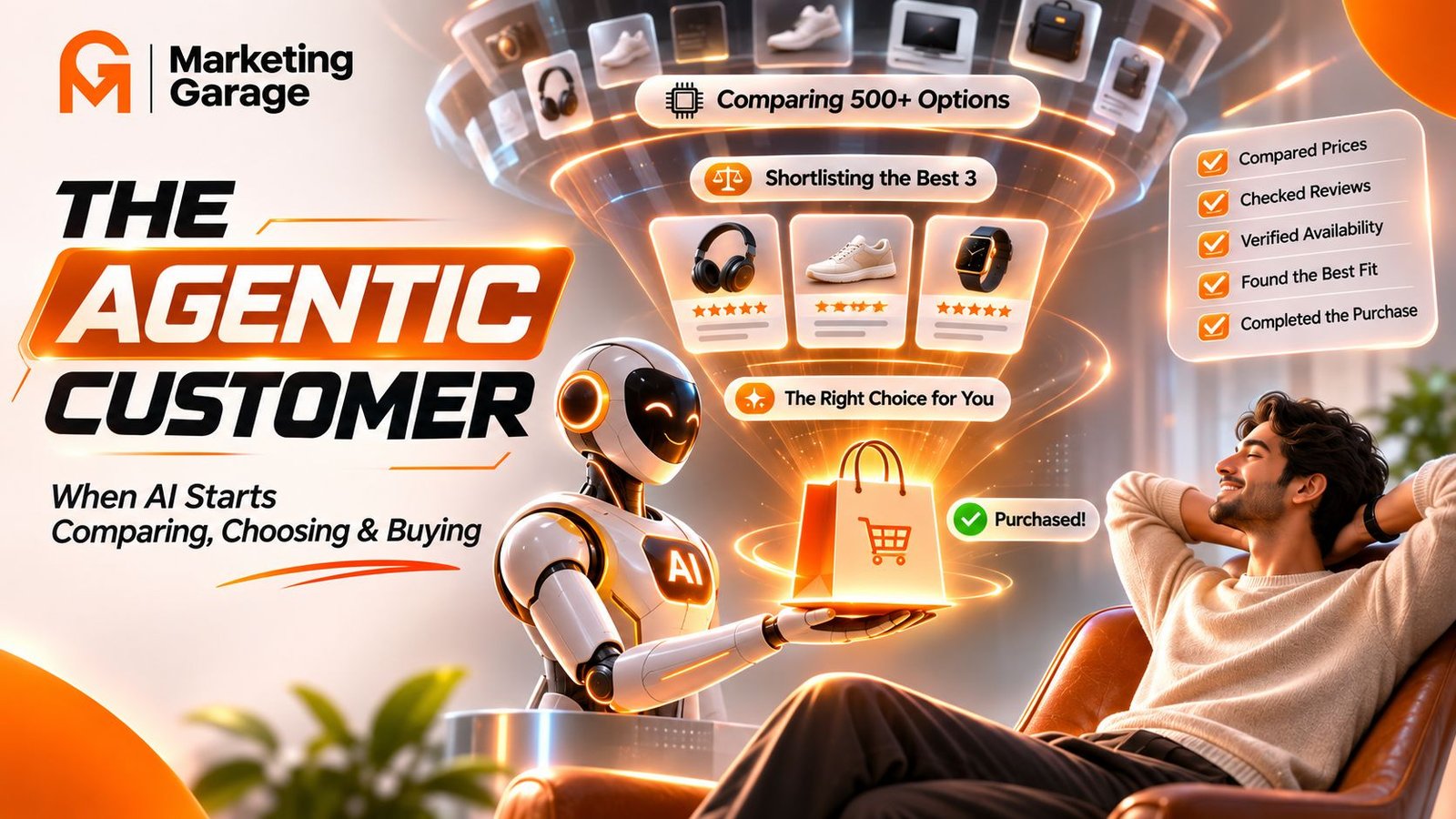
For most of digital marketing history, the customer journey has been built around one assumption: the customer is the one doing the work.
They search. They compare. They read reviews. They open tabs. They watch videos. They visit websites. They check prices. They shortlist. They return later. Eventually, they buy.
Every major part of modern marketing was built around influencing those moments. Search engines helped people discover options. Social media created desire. Websites persuaded. Marketplaces simplified transactions. Retargeting pulled undecided customers back into the funnel.
Now something much bigger is beginning to happen.
The customer may still be human. But increasingly, the journey between intention and purchase may not be.
A consumer can tell an AI what they want, what they can spend, what matters to them and what they absolutely do not want. The AI can search across options, compare products, analyse reviews, eliminate poor matches, check availability, evaluate value and increasingly move toward completing the transaction itself.
The customer does not need to search for the “best option.” They can simply say: “Find the best option for me.”
That shift sounds subtle. It is not.
Because the moment AI starts doing the comparison on behalf of consumers, brands stop competing only for human attention. They also begin competing to survive the machine’s shortlist.
Welcome to the age of the Agentic Customer.
AI Is Moving From Answering Questions to Completing Tasks
The first wave of generative AI changed how people accessed information. You asked a question. AI gave you an answer.
Agentic AI goes one step further. Instead of only explaining what you should do, it can increasingly help do it for you.
Imagine telling an AI: “I need running shoes under ₹12,000. I run four times a week, mostly on roads, I have slightly wide feet, I prefer neutral cushioning and I do not want anything heavy.”
Traditional search gives you links. An AI assistant can give you recommendations. An AI agent can potentially compare models, inspect specifications, study customer reviews, check whether your size is available, compare prices across stores and eventually help complete an authorised purchase.
The journey changes from searching to delegating.
And this is no longer just a futuristic demo. OpenAI has been building commerce infrastructure that allows merchants to expose structured product information to ChatGPT and participate in agent-assisted checkout flows. Google has introduced its Universal Commerce Protocol to connect discovery, purchasing and post-purchase experiences across AI-driven commerce. Visa and Mastercard are also building payment and authentication systems specifically for transactions initiated by AI agents.
In other words, the technology stack required for machines to participate in shopping is being assembled right now: product discovery, inventory, pricing, identity, payment permissions, fraud prevention, checkout and fulfilment.
The real question is no longer: Can AI recommend what someone should buy? The more important question is: How much of the buying process will people eventually choose not to perform themselves?
India May Move Faster Than Many Brands Expect
For Indian marketers, one set of numbers should immediately get attention.
NIQ's 2026 research across India's major metros found that 92% of surveyed consumers had already used AI while shopping, while 96% said they were open to using AI-powered shopping tools.
That does not mean 92% of people are handing their credit cards to autonomous agents. It means something more immediate: consumers are already using AI to discover brands, compare products, understand reviews, evaluate alternatives and find better deals.
That matters because the biggest change may happen before autonomous purchasing becomes mainstream.
A consumer asking “Which phone has the best camera under ₹50,000?”, “Compare these three credit cards”, “Which resort near Mumbai works for a 100-person corporate offsite?”, “Which laptop should I buy for video editing?” or “Which marketing agency understands real estate?” is already outsourcing part of the consideration process.
Once AI begins influencing consideration, brands can lose the customer before the customer ever reaches the website.
The Internet Gave Us Infinite Choice. AI May Remove the Work of Choosing.
Online shopping solved one problem and created another. Consumers gained access to almost unlimited choice. Then they became responsible for processing it.
A person buying a laptop might visit Amazon, Flipkart, YouTube, Reddit, brand websites, review portals and comparison sites before feeling confident enough to make a decision. More information did not always create more certainty. Often, it created more fatigue.
This is one of the reasons agentic commerce could scale so quickly.
McKinsey's 2026 research found that 81% of AI shoppers believed AI was good at narrowing and filtering choices, while 80% valued having to scroll and click less. Another 79% said AI saved meaningful time.
Even more interestingly, in some major purchase categories, between roughly 21% and 30% of AI users said they would be willing to let AI complete the purchase itself.
The real adoption driver may therefore not be excitement around artificial intelligence. It may simply be convenience.
Consumers rarely adopt technology because they want more technology. They adopt it because it removes something annoying.
Google removed the need to remember websites. Amazon reduced the friction of finding products. UPI removed much of the friction from payments. Streaming removed schedules.
Agentic commerce could remove something equally powerful: the work involved in deciding.
AI-Referred Customers Are Already Behaving Differently
One of the most interesting signals is what happens after people use AI to research a purchase.
Adobe's analysis of more than one trillion visits to U.S. retail websites found that by September 2026, traffic referred from AI sources was converting 90% better than non-AI traffic.
Those visitors were also spending more time on retail websites, viewing more pages, adding products to carts at higher rates and generating substantially more revenue per visit.
That is important because it suggests AI may be doing part of the persuasion before the customer reaches the website.
A user who arrives through an AI assistant may already understand the category, know the trade-offs, have a budget in mind and believe the product fits their needs. The website is no longer meeting a completely cold visitor. It may be meeting someone who has already been pre-qualified by a machine.
That changes how marketers should think about traffic. For years, digital marketing rewarded volume: more clicks, more sessions, more reach, more visitors.
In an agentic environment, ten thousand casual visitors may be worth less than one thousand visitors whose AI assistant has already concluded: “This brand looks relevant to what you need.”
The Funnel May Start With a Brief, Not a Keyword
This may be one of the biggest changes for marketers.
Traditional search intent is usually compressed into a few words: “best headphones”, “luxury flats Thane”, “resort near Mumbai”, “digital marketing agency”.
Agentic intent can be far richer.
A customer could say: “I travel twice a month, I hate heavy headphones, I use an iPhone, I need excellent microphone quality for Teams calls and I do not want to spend more than ₹30,000.”
That is not a keyword. That is a brief.
And briefs tell systems far more about the real job the customer is trying to accomplish.
The competitive question therefore changes. A brand no longer needs only to rank for “best headphones.” It needs to become an option the AI can confidently match to a frequent traveller who dislikes heavy products, values call quality, uses Apple devices and has a specific budget.
The winning brand may not simply be the one shouting the loudest. It may be the one the AI can most easily understand, verify and justify.
Your Next Customer May Arrive as Data Before They Arrive as a Person
Marketing has historically focused on what humans see: the headline, the photograph, the ad, the landing page, the packaging and the offer.
All of that still matters. But AI agents introduce a second audience: machines reading the business underneath the marketing.
An agent does not only care that the website looks premium. It needs to understand the product. What does it cost? Is it available? What variations exist? What do customers consistently praise? What problems repeatedly appear in reviews? How fast can it be delivered? What is the return policy? Does the product actually match what the customer requested? Can the transaction be completed reliably?
This is why the commerce protocols being built by OpenAI and Google matter so much. They are designed to give AI systems structured access to information such as product catalogues, pricing, availability and transaction capabilities.
For years, marketers optimised websites so search engines could find them. Then brands optimised creative so social platforms would distribute it. Now marketers are thinking about whether AI systems can recommend them.
Agentic commerce introduces the next question: Can your business be understood well enough by a machine to be bought?
That turns messy product data, conflicting prices, poor reviews, unclear policies and inconsistent inventory into more than operational problems. They become marketing problems.
The Machine May Filter the Market Before the Customer Ever Sees It
This is where things get particularly uncomfortable for marketers.
Traditional digital advertising always gave brands another chance. You could buy another impression, retarget the visitor, bid on the keyword, boost the post, improve the landing page or create a stronger offer.
But imagine a customer gives an AI agent a brief. The AI analyses 500 possible products. It eliminates 450 because they fail basic criteria. It removes another 40 because pricing, reviews or availability are weak. Then it shows the customer ten options. Or five. Or three.
The customer may never even know the other brands existed.
There is no impression. No second page of Google. No clever headline waiting to rescue the product. No retargeting campaign.
The battlefield has moved upstream.
Salesforce reported in 2026 that agentic search as the starting point of shopping journeys had grown 200% year-on-year, while referral traffic coming from AI conversations was also rising sharply across the commerce sites it monitored.
This does not mean search engines or social feeds disappear tomorrow. It means another gatekeeper is emerging — and this one does not simply organise information. It increasingly makes judgments about it.
AI Could Make Brand More Valuable, Not Less
At first glance, agentic commerce sounds like bad news for brand marketing. If AI can compare products objectively, surely everything becomes price, features and reviews.
But that assumes human decisions are objective. They are not.
If five products offer similar performance, similar pricing and similar reviews, a spreadsheet can only go so far. People still care about reputation, design, status, community, identity, trust, culture, taste and the emotional meaning attached to owning something.
An AI may identify three sneakers that technically fit your requirements. But your preference for one of those brands may have been built over ten years of athletes, music, design, culture, stories and experiences.
That preference is not a product specification. It is brand equity.
The more powerful rational comparison becomes, the more valuable genuine emotional differentiation may become.
Brands built almost entirely on vague words like “premium”, “innovative” and “best-in-class” could struggle because AI can increasingly interrogate those claims. Premium compared with what? Better according to whom? What proof exists? What do customers actually say?
Machines may make empty positioning easier to expose. Strong brands, on the other hand, give people something no comparison table can fully calculate: preference before comparison begins.
The Real Barrier Is Not Intelligence. It Is Trust.
There is an enormous difference between asking AI which television you should buy and allowing it to spend ₹80,000 without you.
That difference is trust.
Visa's 2026 consumer research found that only a minority of respondents were fully comfortable allowing generative AI to independently handle payments. Trust increased significantly when established payment brands and controls entered the transaction.
That tells us what agentic commerce will probably look like in practice. Not complete autonomy. Controlled autonomy.
“Reorder this product whenever it falls below ₹3,000.” “Book any nonstop Mumbai–Delhi flight under ₹9,000 between these hours.” “Buy everything on this grocery list, but ask me before replacing unavailable items.” “Find the best three hotels and let me choose before paying.”
People will delegate different levels of authority depending on the purchase. Buying printer ink is easy to automate. Booking a wedding venue is not. Choosing a ₹2 crore apartment certainly is not.
But AI does not need to complete the final transaction to reshape those industries.
A real-estate buyer may still visit the project personally, negotiate and make the final call. But AI could already compare 40 projects using budget, carpet area, developer history, possession timeline, RERA information, connectivity and location.
The final choice may remain human. The shortlist may increasingly not be.
Brands Are Entering the Age of Decision Architecture
Digital marketing spent the last fifteen years perfecting attention. How do we stop the scroll? How do we get the click? How do we increase watch time? How do we make the thumbnail stronger? How do we reduce CPL?
Those questions will not disappear. But agentic commerce adds another discipline: decision architecture.
Can a system understand why your brand exists? Can it identify who the product is for? Can it verify your claims? Can it distinguish you from similar options? Can it access accurate pricing? Can it understand inventory? Can it trust your reviews? Can it transact with you?
Suddenly, marketing connects much more closely with product data, pricing, customer experience, reputation, technology, payments and fulfilment.
The AI evaluating the brand does not care whether a problem belongs to marketing, operations or technology. It simply sees one business.
The strongest brands in an agentic environment may be those where the promise and the infrastructure tell the same story.
Loyalty May Become More Valuable Than Ever
There is another danger hidden inside the rise of AI shopping agents.
The AI itself could become the customer's primary relationship layer. Imagine an assistant that knows your preferred brands, usual sizes, monthly budget, dietary preferences, favourite hotels, travel habits and purchase history.
If that agent becomes the interface through which you shop, brands risk becoming interchangeable suppliers behind the scenes.
Consider two commands: “Buy whichever detergent gives me the best value.” versus “Reorder Ariel.”
The difference between those instructions is brand equity.
In the first scenario, the brand enters a comparison. In the second, the decision has already been made.
Agentic commerce does not destroy loyalty. It may expose exactly how much loyalty a brand actually owns.
The Marketing Garage View
At Marketing Garage, we believe the most important thing about agentic commerce is not that AI might eventually click Buy.
It is that AI is moving into the space between intention and exposure.
That is where marketing has always fought for influence.
Today, brands optimise advertisements, search visibility, content, websites and sales funnels to persuade consumers directly. Tomorrow, there may be another layer in between.
An AI may determine which brands deserve comparison, which claims are credible, which products match the brief, which options provide the best value, which merchants can be trusted and eventually which transaction should move forward.
This does not mean creative dies. It does not mean advertising dies. It does not mean human emotion disappears.
It means marketing has to win two different forms of understanding at once.
The human needs to want you. The machine needs to understand why.
That is a much more interesting marketing problem than simply producing more AI-generated content.
It forces brands to become clearer, better differentiated, easier to verify, more trustworthy and easier to transact with.
Google is building commerce protocols for AI agents. OpenAI is building structured product discovery and checkout systems. Visa and Mastercard are creating payment infrastructure for AI-driven transactions. Salesforce is already seeing agentic search grow rapidly. Adobe is seeing unusually valuable customers arrive from AI-assisted discovery.
The technology will evolve. The platforms will change. The rules will change. But the direction is becoming difficult to ignore.
Search once asked brands to become findable. Social media asked them to become interesting. E-commerce asked them to become easy to buy. AI first asked them to become recommendable.
Agentic commerce is asking something harder: Are you easy enough to understand, trust and transact with that a machine would choose you on someone else's behalf?
Because the next customer may still have a name, a budget, a preference and a credit card. They just may not personally perform every step between “I want this.” and “I bought it.”
And that could make the most important customer journey in marketing the one the customer never actually sees.
Marketing Garage — Where Marketing Meets Motion.
Contact Us
Like exploring new dimensions in art, we seek out every opportunity to create meaningful impact.
-
 100x
Boost your social Presence
-
 100x
Reach worldwide

